 msgvault

OAuth Setup
Google (Gmail)
msgvault requires OAuth credentials to access the Gmail API. This section walks through the complete setup.
Step 1: Create a Google Cloud Project
- Go to Google Cloud Console
- Create a new project or select an existing one
- Note your project ID
Step 2: Enable the Gmail API
- Navigate to APIs & Services > Library
- Search for “Gmail API”
- Click Enable
Step 3: Configure OAuth Consent Screen
- Go to APIs & Services > OAuth consent screen (Google may call this Google Auth Platform)
- Choose External user type (or Internal for Google Workspace)
- Fill in required fields:
- App name:
msgvault - User support email: your email
- Developer contact email: your email
- App name:
- Click Save and Continue
- On the Data Access page, click Add or Remove Scopes
- Add the scope:
https://www.googleapis.com/auth/gmail.modify - Save and continue through the remaining screens
- Under Test users, add all Gmail addresses you want to sync
Step 4: Create OAuth Client Credentials
- Go to APIs & Services > Credentials
- Click Create Credentials > OAuth client ID
- Choose Desktop app as the application type
- Name it
msgvault(or similar) - Click Create
- Download the JSON file
- Save it as
client_secret.jsonin a secure location
Step 5: Configure msgvault
Create config.toml in your msgvault data directory:
- macOS / Linux:
~/.msgvault/config.toml - Windows:
C:\Users\<you>\.msgvault\config.toml
[oauth]client_secrets = "/path/to/your/client_secret.json"On Windows, use forward slashes or escaped backslashes for the path:
[oauth]client_secrets = "C:/Users/you/Downloads/client_secret.json"Step 6: Add Your Account
msgvault add-account you@gmail.comThis opens your browser to Google’s OAuth consent page. Sign in, grant access, and tokens are stored locally in ~/.msgvault/tokens/.
Multiple Accounts
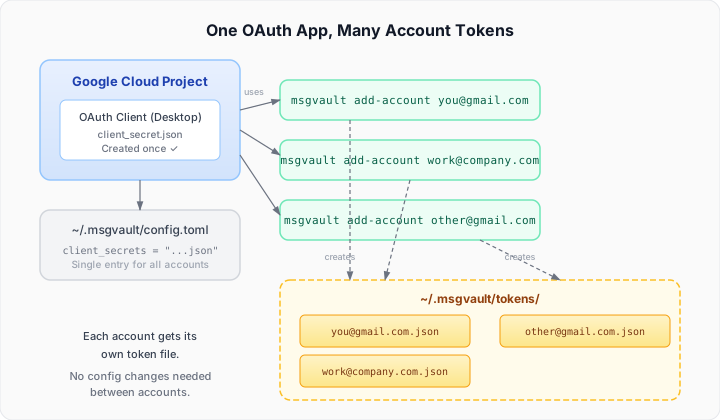
For personal Gmail accounts, a single client_secret.json works for all of them. Each add-account call creates a separate token file:
msgvault add-account personal@gmail.commsgvault add-account other@gmail.com
msgvault sync # syncs all accountsGoogle Workspace Accounts
Many Google Workspace organizations restrict OAuth to apps created within their own org. If you get an “access denied” or “app blocked” error when authorizing a Workspace account with your personal OAuth app, the org likely requires its own app.
To handle this, create a separate Google Cloud project inside the Workspace org (Steps 1-4 above), then add it as a named OAuth app in config.toml:
[oauth]client_secrets = "/path/to/personal_secret.json"    # default for personal Gmail
[oauth.apps.acme]client_secrets = "/path/to/acme_workspace_secret.json"
Then specify the app when adding Workspace accounts:
msgvault add-account you@acme.com --oauth-app acmemsgvault add-account personal@gmail.com # uses defaultThe binding is stored per account, so sync, verify, and serve automatically use the correct credentials. You only need --oauth-app when first adding or rebinding an account.
To switch an existing account to a different OAuth app:
msgvault add-account you@acme.com --oauth-app acme # re-authorizes with new appTo move an account back to the default app:
msgvault add-account you@acme.com --oauth-app "" # clears the bindingHeadless Server Setup
When running msgvault on a headless server (SSH, VPS, Docker), there is no browser available for OAuth. Google’s device code flow does not support Gmail scopes, so you must authorize on a machine with a browser and copy the token to your server.
Run --headless to see the setup instructions:
msgvault add-account you@gmail.com --headlessThis prints:
=== Headless Server Setup ===
Google's OAuth device flow does not support Gmail scopes, so --headlesscannot directly authorize. Instead, authorize on a machine with a browserand copy the token to your server.
Step 1: On a machine with a browser, run:
    msgvault add-account you@gmail.com
Step 2: Copy the token file to your headless server:
    ssh user@server 'mkdir -p ~/.msgvault/tokens'    scp ~/.msgvault/tokens/you@gmail.com.json user@server:~/.msgvault/tokens/
Step 3: On the headless server, register the account:
    msgvault add-account you@gmail.com
The token will be detected and the account registered. No browser needed.
Step-by-Step
-
On your local machine (with a browser), install msgvault and run:
Terminal window msgvault add-account you@gmail.comComplete the OAuth flow in your browser.
-
Copy the token to your headless server:
Terminal window ssh user@server mkdir -p ~/.msgvault/tokensscp ~/.msgvault/tokens/you@gmail.com.json user@server:~/.msgvault/tokens/ -
On the headless server, register the account:
Terminal window msgvault add-account you@gmail.commsgvault detects the existing token and registers the account. Output:
Account you@gmail.com is ready.You can now run: msgvault sync-full you@gmail.com -
Sync your email:
Terminal window msgvault sync-full you@gmail.com
The token file contains OAuth refresh tokens that are automatically renewed. You only need to copy it once unless you revoke access.
Microsoft 365 (Outlook / Hotmail)
The add-o365 command connects Outlook.com, Hotmail, Live.com, and Microsoft 365 organizational accounts via OAuth2 with XOAUTH2 IMAP authentication. No app password is needed.
Prerequisites: Azure AD App Registration
You need to register an application in Microsoft Entra (Azure AD) before using add-o365.
- Go to Azure Portal and navigate to Microsoft Entra ID > App registrations > New registration
- Set the fields:
- Name:
msgvault - Supported account types: “Accounts in any organizational directory and personal Microsoft accounts”
- Redirect URI: Platform = Mobile and desktop applications, URI =
http://localhost:8089/callback/microsoft
- Name:
- Click Register
- Under API permissions, click Add a permission > APIs my organization uses, search for Office 365 Exchange Online, select Delegated permissions, then add
IMAP.AccessAsUser.All - Under Authentication, enable Allow public client flows (required for PKCE)
- Copy the Application (client) ID from the app’s Overview page
Configure msgvault
Add a [microsoft] section to your config.toml:
[microsoft]client_id = "your-azure-app-client-id"To restrict authorization to a specific organization, set tenant_id:
[microsoft]client_id = "your-azure-app-client-id"tenant_id = "your-org-tenant-id"When tenant_id is omitted (or set to "common"), both personal Microsoft accounts and organizational accounts can authorize.
Add Your Account
msgvault add-o365 you@outlook.comThis opens your browser for Microsoft OAuth consent. After you authorize, msgvault:
- Validates the token matches the email you specified
- Auto-detects the correct IMAP host based on account type
- Configures XOAUTH2 authentication automatically
Personal accounts (hotmail.com, outlook.com, live.com, msn.com) connect to outlook.office.com. Organizational accounts (company Microsoft 365) connect to outlook.office365.com. This detection is automatic.
To restrict to a specific tenant at authorization time:
msgvault add-o365 you@company.com --tenant your-org-tenant-idSync Your Email
After adding the account, sync it the same way as any other account:
msgvault sync-full you@outlook.comHeadless Servers
On a headless server (SSH, VPS, Docker), authorize on a machine with a browser and copy the token file to the server:
- On your local machine, run
msgvault add-o365 you@outlook.comand complete the browser flow. - Copy the token to the server:
Terminal window ssh user@server mkdir -p ~/.msgvault/tokensscp ~/.msgvault/tokens/microsoft_you@outlook.com.json \user@server:~/.msgvault/tokens/ - On the server, run
msgvault add-o365 you@outlook.comagain. It detects the existing token and registers the account without a browser.
Both machines must use the same client_id in their [microsoft] config.